
Monthly manufacturing shift schedule: Excel template
Download a blank shift schedule in XLSX or CSV. Assign people to work areas, record day and night shifts and check open positions before publishing the plan.
Vakhta / Employee requests
Workers submit Telegram requests, from absence or shift cover to corrections, appeals and suggestions. A responsible person records the decision; schedule effects depend on request type.
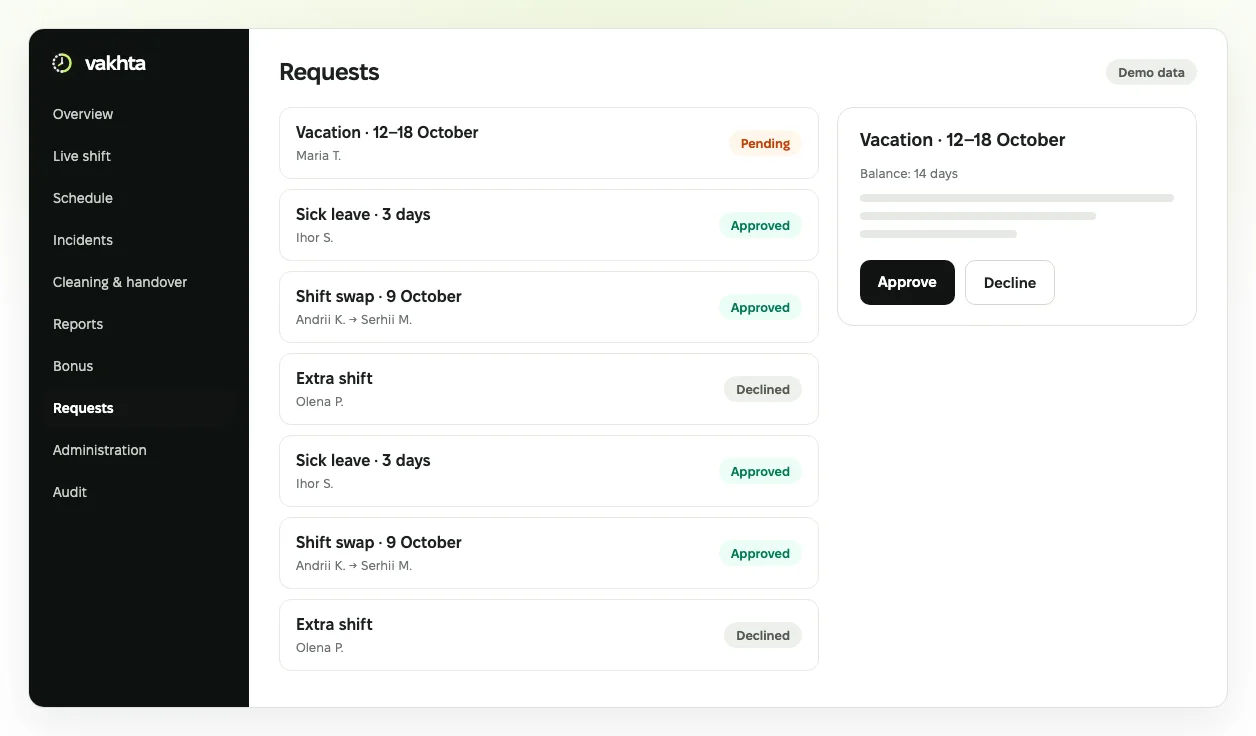
Interface illustration with fictional data. The real interface evolves and may differ.
Keep approvals out of scattered personal conversations.
Book a demoA worker asks for leave in a private message to the supervisor, the request never reaches the planner, and the schedule ends up with a gap. In Vakhta the worker files a request in Telegram: vacation, day off, sick leave, shift swap, late arrival, early leave, a time correction or a score appeal.
Each request has a route: who decides and by when. The reviewer sees it in the panel inbox and records a decision with a comment, and the worker receives the answer in the bot. New requests appear in one list with a filter by type.
Decisions are made by the people responsible for each step: the shift supervisor, the unit manager or HR. A shift swap first needs the colleague’s consent in the bot. Approved leave or a swap creates a new schedule version, and an approved correction changes time records through a separate entry while the original data stays.
Only HR can see a medical document photo attached to sick leave. If a worker asks in person, an authorized user can file the request on their behalf in the panel. Requests involving potential overtime also wait for a decision in this section.
For the pilot, choose the request types that get lost most often today, for example shift swaps and time corrections. Agree who decides each type and by when.
Measure the time from submission to decision, count overdue requests and check whether the planner sees schedule changes without extra phone calls. Ask a few workers whether they understand which step their request has reached.
Also check sick leave: does HR receive medical documents on time, and are they hidden from people who do not need them? Workers’ trust in the system depends on it.
A request in Vakhta does not replace the HR documents or orders that the law or your internal procedures require. The system does not decide instead of a person and does not calculate holiday pay.
Launch needs an employee list with linked Telegram accounts, the unit structure and an assigned reviewer for each request type. An administrator, production head or HR can cancel or shorten approved leave with a reason that stays in the history. The same dialog can return the worker to the schedule, and the worker receives the return date in the bot.
Choose one process, agree who is responsible and evaluate changes using recorded facts.
Download a blank shift schedule in XLSX or CSV. Assign people to work areas, record day and night shifts and check open positions before publishing the plan.
Agree what the incoming shift needs to know about an area, its condition and unresolved questions. Download and adapt this template to your process.
Separate what happened from an assumption about its cause. Use this log to discuss recurring obstacles with the shift supervisor.
Working time accounting in manufacturing with 12-hour shifts: planned vs actual hours, night work, breaks, overtime and the timesheet. A worked week and a template.